

Blog
A Practical Preventive-Maintenance Plan for Industrial Woodworking Machinery

Equipment Ownership
A Practical Preventive-Maintenance Plan for Industrial Woodworking Machinery
Build a manufacturer-led maintenance system around machine condition, operating hours, dust and residue, tooling, utilities, safety devices, records, and assigned responsibility.
Preventive maintenance works when required tasks are visible, scheduled, assigned, and recorded. A binder that no one opens is not a maintenance system, and a universal checklist cannot replace the instructions for a specific machine.
Build the plan from current manufacturer documentation, then adapt the schedule to the shop’s operating hours, materials, environment, duty, and observed condition.
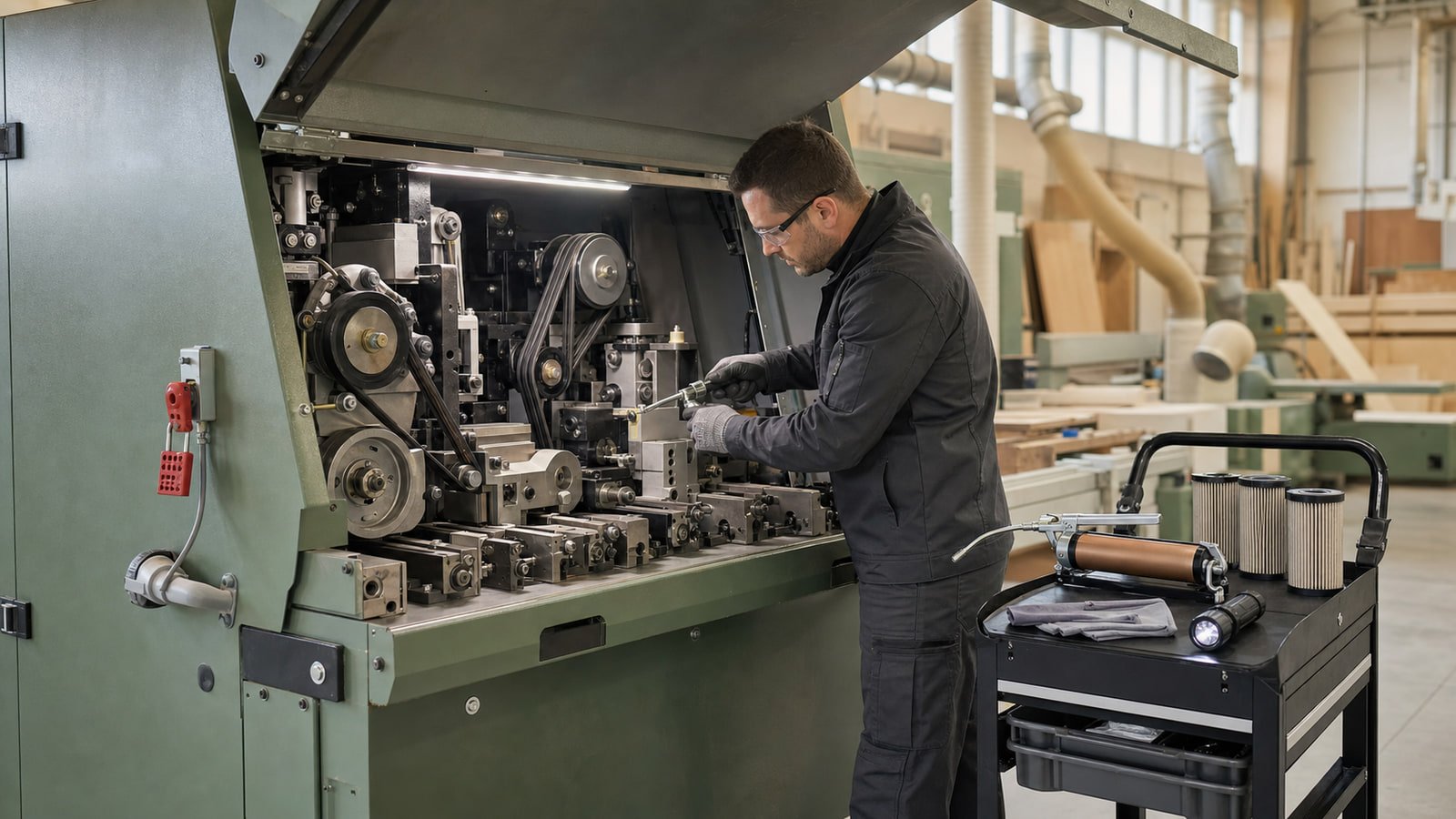
> Only trained and authorized personnel should inspect or service machinery. Follow the manufacturer’s shutdown, isolation, lockout, stored-energy, guarding, access, and personal-protective-equipment instructions, together with applicable workplace requirements.
Start with a complete equipment register
Create one controlled record for every machine and major supporting system. Include:
- Manufacturer, model, and serial number
- Location and internal asset number
- Installation or commissioning records, when available
- Current manuals and electrical, pneumatic, hydraulic, or dust diagrams
- Manufacturer service contacts and parts references
- Selected options and control or software versions
- Lubricants, filters, belts, blades, knives, inserts, and other specified items
- Manufacturer maintenance intervals
- Responsible operator, maintenance owner, and backup contact
Store the records where the people doing the work can access the current version. Remove superseded instructions from active use without destroying records the business must retain.
Convert manuals into scheduled tasks
Manufacturer instructions may define work by shift, operating hours, days, weeks, months, or another interval. Transfer each required task into a maintenance system without changing the interval or method unless an authorized source approves the change.
A practical schedule can group work into:
- Pre-start or operator checks
- End-of-shift cleaning and observation
- Weekly or operating-hour tasks
- Planned monthly or quarterly work
- Annual or major-service inspections
- Condition-triggered work
Usage-based intervals should be tracked from a reliable hour meter, cycle count, controller record, or operating log. Calendar reminders alone can under-service a heavily used machine and over-service one that is rarely operated.
Separate operator care from maintenance work
Define what a trained operator may do and what requires maintenance staff, a qualified trade, or manufacturer service. The boundary can differ by machine.
An operator checklist may cover approved visual checks, housekeeping, fluid or pressure observations, tooling condition, unusual noise, alarms, and reporting. Work involving guards, electrical cabinets, stored energy, alignment, drives, internal access, or safety circuits may require different authorization and procedures.
Clear task ownership prevents two common failures: everyone assumes someone else completed the work, or an unqualified person attempts a task outside their role.
Control dust, chips, and process residue
Wood dust, chips, abrasive particles, adhesive, finish residue, and pitch can obstruct sensors, affect movement, retain heat, or hide developing problems. Use only the cleaning methods and products approved for the exact machine and material.
The plan should identify:
- Areas checked during normal operation
- Areas accessed only after approved shutdown and isolation
- Dust ports, hoods, hoses, gates, and internal passages
- Filters, separators, containers, and disposal points
- Adhesive pots, rollers, nozzles, scrapers, and application components
- Optical sensors, switches, scales, and control surfaces
- Approved brushes, vacuums, cleaners, and waste containers
Do not default to blowing dust with compressed air. It can disperse fine material, drive contamination into components, or conflict with machine and facility safety procedures.
Lubricate by specification, not habit
More lubricant is not always better. Use the product, quantity, location, and interval stated by the manufacturer. Mixing incompatible products or contaminating a clean lubrication point can cause problems the maintenance task was meant to prevent.
Label dispensing equipment and storage clearly. Record the lubricant specification, not only a shop nickname. Inspect automatic lubrication systems for reservoir level, delivery, alarms, damaged lines, and evidence that lubricant reaches the intended point.
If a product is unavailable, obtain an approved equivalent instead of substituting by appearance or general type.
Treat tooling as a controlled asset
Dull, damaged, contaminated, or incorrectly installed tooling can affect cut quality, loading, heat, vibration, and machine condition. Create a tooling process that covers:
- Inspection before and after use
- Cleaning by an approved method
- Sharpening or replacement criteria
- Correct holder, collet, arbor, or mounting component
- Torque and installation procedure
- Balance or speed limitations where applicable
- Labeled storage and protection from damage
- Service history and retirement
For CNC machines, keep tool-library data consistent with the physical tool and holder. For saws, planers, moulders, and sanders, record which blade, knife, head, or abrasive produced the approved setup.
Inspect feed and motion components
Belts, chains, tracks, rollers, bearings, guides, slides, screws, racks, conveyors, and pressure components wear differently by machine and duty. Follow the manual for inspection, adjustment, lubrication, cleaning, and replacement.
Record symptoms such as slipping, inconsistent feed, heat, noise, vibration, play, tracking changes, marking, or loss of position. A trend across several inspections can be more useful than a single observation.
Do not compensate for mechanical condition by increasing pressure, changing a control parameter, or repeatedly recalibrating without investigating the cause.
Include air, dust, hydraulic, and cooling systems
Supporting utilities affect machine operation and require their own checks. Depending on the equipment, the plan may address:
- Compressed-air pressure, quality, leaks, drains, filters, and regulators
- Dust-collection hoses, ducts, gates, airflow indicators, filters, and containers
- Hydraulic fluid condition, level, leaks, filters, temperature, and hoses
- Vacuum pumps, seals, filters, and workholding surfaces
- Cooling fans, heat exchangers, chillers, and cabinet filters
- Electrical enclosures, connections, drives, and controls inspected by qualified personnel
Use specified shutdown and isolation procedures before opening or servicing any system.
Verify protective systems through approved procedures
Guards, interlocks, emergency controls, brakes, sensors, light curtains, mats, enclosures, and other protective devices must remain in their approved condition. The manufacturer or qualified safety professional should define inspection and functional-test methods and intervals.
Never bypass a protective device to keep production moving. Remove affected equipment from service and follow the established escalation process when a guard, interlock, emergency stop, brake, or other safety-related function is damaged or does not respond as required.
Document the result of required checks and any corrective action.
Protect calibration and process settings
Alignment and calibration affect the part and the machine. Identify which checks an operator can perform using reference material or measurement tools and which adjustments require a trained technician.
Keep master settings, offsets, recipes, tool data, backups, and software information under change control. When a parameter changes, record who changed it, why, the prior value, the new value, and how the result was verified.
For networked or computer-controlled equipment, include approved backup, access, and update procedures. Do not install software or connect devices without considering the manufacturer’s requirements and the business’s security practices.
Stock critical items deliberately
A recommended-parts list is a starting point. Prioritize spares by failure impact, expected wear, lead time, storage life, compatibility, and whether replacement requires special service.
Possible categories include:
- Machine-specific wear parts
- Filters and approved lubricants
- Belts, seals, hoses, scrapers, brushes, and sensors
- Tooling consumables and mounting hardware
- Fuses or electrical items specified for authorized replacement
- Adhesive-system service items
- Computer or control backups, where permitted
Confirm exact part numbers against the model and serial number. Label storage and review shelf life or condition periodically.
Use records to improve the plan
A completed work order should show the machine, date, operating hours, task, observations, measurements, parts or fluids used, person completing the work, and any required follow-up.
Review records for recurring alarms, repeat adjustments, increasing vibration, shorter tooling life, leaks, overheating, dust buildup, product defects, or unplanned stops. The objective is to identify a developing condition before it becomes normal.
When the machine configuration, material, tooling, work schedule, dust system, or utility supply changes, review the maintenance plan. A schedule written for the original process may not fit the new duty.
A simple implementation sequence
- Build the equipment register.
- Gather the current manufacturer manuals and service bulletins.
- Extract every required task and interval.
- Assign authorized roles and escalation paths.
- Add tasks to a visible scheduling system.
- Prepare approved tools, supplies, and spare parts.
- Train the people responsible for each task.
- Record completed work and abnormal findings.
- Review missed tasks and repeat problems each month.
- Update the plan when equipment or operating conditions change.
A sound preventive-maintenance program is specific enough to guide action and disciplined enough to show what actually happened.
Request Equipment Documentation or Support
Share the machine, material, application, utilities, and site details that matter to your project.
Request Equipment Documentation or SupportRelated Reading
More Machinery Guidance
What to Compare Before Buying an Edgebander
Define your panels, edge materials, finish standard, production pace, utilities, and maintenance plan before comparing edgebander configurations.
Read guide
Planning Dust Collection for Multiple Woodworking Machines
Build a shop dust-collection plan around connected machines, simultaneous use, duct resistance, filtration, waste handling, facility conditions, and future changes.
Read guide
Jointer, Planer, or Combination Machine? Mapping the Stock-Preparation Workflow
Understand what each machine contributes to flattening, straightening, and thicknessing stock before deciding between separate and combination equipment.
Read guide